While traveling to Makkah and Madinah, keep your heart engaged in the remembrance of Allah and His Messenger ﷺ.
Prior to Departure
Family and Friends
Before setting out on your journey—or any journey—take time to be with your family. Seek your parents’ blessings if they are alive, or make du’a for them if they have passed away. Visit relatives, neighbors, teachers, mentors, and friends to seek their forgiveness and bid them farewell. Embrace them before leaving and ask for their prayers. As ‘Umar ibn al-Khattab (رضي الله عنه) said:
I asked the Prophet ﷺ for permission to perform Umrah. He granted me permission and said: ‘Do not forget us, my brother in your du’a.’ He said something which was more pleasing to me than owning the world.’ According to another report he said: ‘Let us share in your du’a, my brother.’
You can recite this du’a for family and friends:
❁ أَسْتَوْدِعُكُمُ اللهَ الَّذِي لَا تَضِيعُ وَدَائِعُهُ
Astawdiʿukumu Llāha lladhī lā taḍīʿu wadā’iʿuh.
I leave you in the care of Allah, Who does not allow anything entrusted to Him to be lost.1
Abu Hurairah (رضي الله عنه) narrated that the Prophet ﷺ said:
There are three supplications that will undoubtedly be answered: the supplication of one who has been wronged, the supplication of the traveller, and the supplication of a father for his child.
[Narrated in Sunan ibn Majah]
Well-wishers are encouraged to read the following du’a for the traveller:
أَسْتَوْدِعُ اللهَ دِينَكَ وَأَمَانَتَكَ وَخَوَاتِيمَ عَمَلِكَ ❁ زَوَّدَكَ اللهُ التَّقْوَى ❁ وَغَفَرَ ذَنْبَكَ ❁ وَيَسَّرَ لَكَ الْخَيْرَ حَيْثُمَا كُنْتَ ❁
Astawdiʿu Llāha dīnaka wa amānataka wa khawatīma ʿamalik, zawwadaka Llāhu t-taqwā, wa ghafara dhanbak, wa yassara laka l-khayra ḥaythumā kunt.
I entrust your religion, your integrity and your final deeds to Allah’s protection. May Allah grant you taqwa, forgive your sins and facilitate goodness for you, wherever you are.2
This du’a may also be read for the pilgrim:
❁ اَللَّهُمَّ اطْوِ لَهُ الْبُعْدَ وَهَوِّنْ عَلَيْهِ السَّفَرَ
Allāhumma-ṭwi lahu l-buʿda wa hawwin ʿalayhi s-safar.
O Allah, shorten the distance for him and make the journey easy for him.3
Salah
Before you set out, perform two rak’ahs with the intention of seeking Allah’s safeguard during your travels.
Abu Hurairah (رضي الله عنه) reports that the Prophet ﷺ said:
When you intend to leave your house, then perform two rak’ahs of salah. These (two rak’ahs of salah) will safeguard you from a harmful exit. When you enter your house (after the journey, then again) perform two rak’ahs of salah. These (two rak’ahs of salah) will safeguard you from a harmful entry.
[Narrated in Musnad al-Bazzar]
Muqattam ibn al-Miqdam (رضي الله عنه) also reported that the Prophet ﷺ said:
No-one has left his family with anything better than two rak’ahs that he performs among them when he intends to travel.”4
Some scholars recommend reciting Surah al-Kafirun (Surah 109) in the first rak’ah, after Al-Fatiha, and Surah al-Ikhlas (Surah 112) in the second. Others suggest reciting Surah al-Falaq (Surah 113) in the first rak’ah and Surah al-Nas (Surah 114) in the second.
After saying salam, it is recommended to recite Ayat al-Kursi. It is reported that anyone who recites this verse before leaving home will be protected from any harm or misfortune until they return.
It is also recommended to recite Surah al-Fil (Surah 105). The renowned Shafi’i scholar, Abu’l Hasan al-Qazwini, who was known for his miracles, stated that it provides protection from all forms of evil. Abu Tahir ibn Jahshawi also mentioned:
“I was fearful, so I went to al-Qazwini and asked him for a du’a. He told me: ‘Whoever wants to travel and fears an enemy or loneliness should recite Li-īlāfi Quraysh, for it is security from all evil.’ I recited it and no incident has befallen me until now.
Du’a
After the prayer, make du’a for an easy journey and ask for assistance during your travels. You may say the following:
اللّٰهُمَّ إِلَيْكَ تَوَجَّهْتُ ❁ وَبِكَ اعْتَصَمْتُ ❁ اللّٰهُمَّ اكْفِنِي مَا هَمَّنِي وَمَا لَا أَهْتَمُّ لَهُ ❁ اللّٰهُمَّ زَوِّدْنِي التَّقْوَى ❁ وَاغْفِرْ لِي ذَنْبِي ❁ وَوَجِّهْنِي لِلْخَيْرِ أيْنَمَا تَوَجَّهْتُ❁
Allāhumma ilayka tawajjaht, wa bika-‘taṣamt. Allāhumma-kfinī mā hammanī wa mā lā ahtammu lah. Allāhumma zawwidnī t-taqwa, waghfir lī dhanbī, wa wawajjihnī li l-khayri aynamā tawajjaht.
O Allah, to You I turn, and to You I hold fast. O Allah, be my sufficiency for that which preoccupies me and that which does not preoccupy me. O Allah, provide me with fear of You, forgive me my sins, and turn me towards good wherever I may turn.6
Upon leaving the house, recite:
بِسْمِ اللهِ ❁ تَوَكَّلْتُ عَلَى اللهِ ❁ وَلَا حَوْلَ وَلَا قُوَّةَ إِلَّا بِاللهِ
Bismi Llāh. Tawakkaltu ʿalā Llāh, wa lā ḥawla wa lā quwwata illā bi Llāhi.
In the Name of Allah. I put my tawakkul (trust; reliance) in Allah. There is no power and no might except with Allah.
[Narrated in Sunan Abu Dawud]
Then read the following:
الَّهُمَّ إِنِّي أَعُوذُ بِكَ أَنْ أَضِلَّ ❁ أّوْ أُضَلَّ ❁ أَوْ أَزِلَّ ❁ أَوْ أُزَلَّ ❁ أَوْ أَظْلِمَ ❁ أَوْ أُظْلَمَ ❁ أَوْ أَجْهَلَ ❁ أَوْ يُجْهَلَ عَلَيَّ ❁
Allahumma innī aʿūdhu bikā an aḍilla, aw uḍalla, aw azilla, aw uzalla, aw aẓlima, aw uẓlama, aw ajhala, aw yujhala ʿalayya.
O Allah, I seek protection in You from misleading (others) and from being misled; from causing others to err and from being caused to err; from wronging and oppressing others and from being wronged or oppressed; from behaving with ignorance or (meeting those who) behave with ignorance.
[Narrated in Sunan Abu Dawud]
Follow the Prophet’s ﷺ example by giving sadaqah before your journey; it repels harm and invites Allah’s mercy.
Du’a During Travel
There are several supplications recommended to be recited at different points during your journey. At the very least, you should say “Bismillah” when boarding your means of transport and “Alhamdulillah” once you are seated.
Dispensations for the Traveller
Given the often challenging nature of travel, you are granted certain allowances starting from your hometown. Abu Hurairah (may Allah be pleased with him) reported that the Prophet ﷺ said:
Travelling is a kind of torture as it prevents one from eating, drinking and sleeping properly. So, when one’s needs are fulfilled, one should return quickly to one’s family.
[Narrated in Sahih al-Bukhari]
As a traveler, you are permitted to do the following:
- Shorten the obligatory four-rak’ah prayers to two rak’ahs, a practice known as qasr (Arabic: قصر). This applies only if you are praying alone or leading the prayer.
- Combine prayers, known as jama’ (Arabic: جمع), although this does not apply to followers of the Hanafi school.
- Postpone fasting during Ramadan.
According to the Hanafi school of thought, you are considered a traveler if you intend to travel 81 kilometers away from your place of residence. These allowances will apply once you cross the boundaries of your hometown.
Shortening Salah (Qasr)
Shortening the salah during travelling is a commandment and a mercy from Allah:
وَإِذَا ضَرَبْتُمْ فِي الْأَرْضِ فَلَيْسَ عَلَيْكُمْ جُنَاحٌ أَنْ تَقْصُرُوا مِنَ الصَّلَاةِ إِنْ خِفْتُمْ أَنْ يَفْتِنَكُمُ الَّذِينَ كَفَرُوا إِنَّ الْكَافِرِينَ كَانُوا لَكُمْ عَدُوًّا مُبِينًا
And when you (Muslims) travel in the land, there is no sin on you if you shorten your Salah (prayer) if you fear that those who commit Kufr (disbelieve) may attack you; verily, the Kafirin (disbelievers) are ever open enemies unto you.
[Surah an-Nisa, 4:101]
It was a practice of the Prophet ﷺ, as mentioned by Umar (رضي الله عنه), who said:
The prayer while travelling is two rak’ah, and Friday is two rak’ah, and Eid is two rak’ah. They are complete and are not shortened, as told by Muhammad ﷺ.
[Narrated in Sunan Ibn Majah]
During your journey, the Dhuhr, Asr, and Isha prayers should be shortened from four rak’ahs to two rak’ahs. However, this does not apply to the Fajr and Maghrib prayers, which remain at two and three rak’ahs, respectively.
The ruling of qasr does not apply to sunnah prayers, although it is not sinful to omit them while traveling.
Note: the two rak’ahs before Fajr and Witr were prayers that the Prophet ﷺ never omitted, even when travelling.
You should continue to perform salah in the shortened manner during your Hajj or Umrah unless you intend to stay in Makkah or Madinah for more than 15 days. For instance, if you plan to spend 13 days in Makkah and 12 days in Madinah, you should still shorten the prayers.
While in Makkah or Madinah, you will likely be praying in congregation behind the Imam. In this case, you must complete the full four rak’ah prayer. It is not valid to leave the congregation after the second rak’ah.
Combining Salah (Jama’)
Jama’ refers to the practice of combining two prayers within a single prayer time. This is accepted in the Shafi’i, Maliki, and Hanbali schools of thought, but is not commonly followed by Hanafis.
There are two valid types of jama’:
- Jama’ al-taqdim (Arabic: جمع التقديم; “early joining”) – combining the prayers at the time of the earlier prayer, for example, combining Dhuhr with Asr at the time of Dhuhr, and Maghrib with Isha at the time of Maghrib.
- Jama’ al-takhir (Arabic: جمع التأخير; “late joining”) – combining the prayers at the time of the later prayer, for example, combining Dhuhr with Asr at the time of Asr, and Maghrib with Isha at the time of Isha.
Either of these may be performed depending on your circumstances.
According to the Hanafi madhhab, the only time when prayers may be combined is during the third day of Hajj in Arafat and Muzdalifah. Prayers may not be combined in any other circumstance.
Omission of Fasting
If you are traveling to perform Umrah during Ramadan, fasting is optional. However, it is preferable to fast if it does not cause significant difficulty. If you decide not to fast, you will need to make up for the missed fasts at a later time.
Prayer on a Plane
During your journey, you should aim to perform the mandatory prayers without causing inconvenience to others. Below are some tips on how to pray while on a plane.
Wudhu
If you need to perform wudhu during your flight, follow these steps:
- Wash your face once.
- Wash both arms (including hands and elbows) once.
- Wipe at least a quarter of your head.
- Wash both feet (including ankles) once.
These are the obligatory actions of wudhu according to the Hanafi madhhab. This method helps conserve water and allows you to complete the process quickly.
Avoid splashing water and spilling it on the floor while washing your feet, as this could pose a safety risk to other passengers
Praying in an Airplane
Every effort should be made to stand and face the Qibla while performing obligatory prayers on a flight. Airlines like Saudia offer designated areas where you can pray.
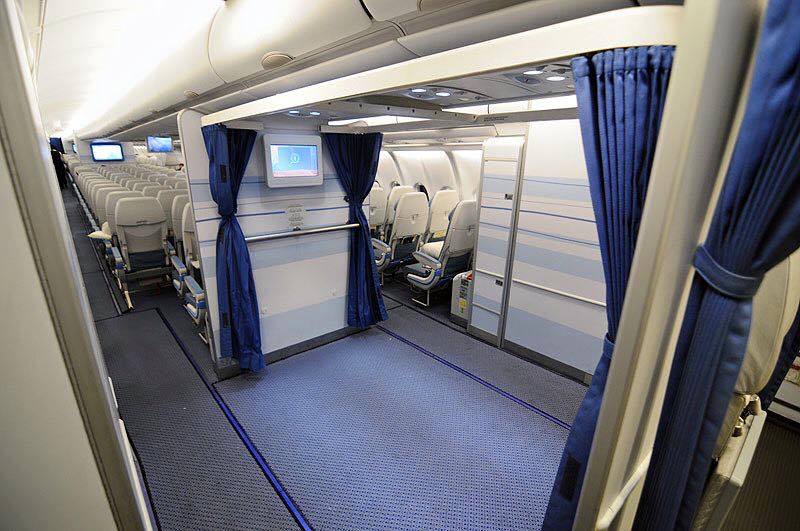
Other airlines don’t have prayer facilities which may pose a problem. In these aeroplanes, standing in certain areas may pose a safety risk or be an inconvenience to others, particularly if it’s a smaller plane.
There is a difference of opinion about what should be done in this scenario. Some scholars believe that it is acceptable for the prayer to be performed sitting down. Ruku’ (bowing) and sujud (prostration) should be gestured by bowing the head, with the sujud more pronounced than the ruku’.
Other scholars are of the opinion that the prayer must be performed sitting down and then be repeated after landing.
It may then be advisable to take the cautious approach and perform the prayer in the best manner possible during the flight, without inconveniencing others, and repeating it when it can be performed properly.
Nevertheless, you should still ask if there are any vacant spaces on the plane where the prayer can be performed. After all, the prayer itself shouldn’t take a great deal of time.
When to Pray in an Airplane
Before performing salah, it’s important to determine the direction of the Qibla. This is relatively simple, as most international flights are equipped with satellite navigation devices that show the plane’s current direction. Using this information, it’s easy to figure out the Qibla’s direction. Additionally, since you’ll likely be flying toward Saudi Arabia, the plane will generally be facing the Qibla.
As for the prayer times, the starting times for Fajr, Maghrib, and Isha can be determined by observing the view outside the window. Fajr begins when dawn breaks, Maghrib starts when the sun sets, and Isha begins once the red glow of the sunset disappears.
Ihram on the Plane
It’s more practical to change into your Ihram clothing before boarding and then make your niyyah (intention) to enter into the state of Ihram as the designated Miqat approaches. The majority of toilets on planes are quite small, making it challenging to change into Ihram in such a confined space.
If you choose to change during the flight, your plane might have a toilet with a changing table that you can use, though space will still be limited. If you’re flying with an airline like Saudia, there may be a small prayer area where you can put on your Ihram. Make sure to change well in advance of the Miqat, as there may be a rush of passengers preparing for the same thing as the Miqat nears.
When you’re ready to make your niyyah to enter Ihram, remember to remove your underwear and headgear (if you’re male) if you haven’t already, and ensure you’re fully aware of the restrictions of Ihram.
Tip: don’t forget any clothing or footwear on the plane before you disembark.
Other Things to Do on the Plane
Make the most of your time during the flight. Review your notes and guidebooks; the more you memorize now, the less you’ll need to rely on others for guidance later. If you feel you’ve studied enough, take time to revise what you’ve learned. Given the vastness of the topic of Hajj and Umrah, it’s likely there are things you’ve missed. If you come across something unclear, don’t hesitate to ask others for clarification.
Additionally, dedicate some time to worship—whether it’s reading the Quran, engaging in other forms of dhikr, or sending salutations upon the Prophet ﷺ.
Checklist for the Journey
- Undertake the journey with the sole intention of seeking Allah’s pleasure, and do not mix it with any other motives.
- Guard yourself against performing actions for the sake of showing off, pride, or seeking attention.
- Purify your heart from any negative feelings or ill-will towards others.
- If you have wronged anyone or taken their rights, seek their forgiveness and make amends.
- Settle any outstanding debts you owe to others or make arrangements for their repayment.
- If you have taken someone’s wealth unjustly, return it to them or their family.
- Return any borrowed items to their rightful owner.
- Seek forgiveness for all your sins, both major and minor.
- Make up any missed prayers, fasts, and zakat to the best of your ability.
- Learn and familiarize yourself with the rules and regulations of Hajj and Umrah.
- Carry a guidebook that outlines how to perform the rites of Hajj and Umrah.
- Seek the blessings and approval of your parents before you depart.
- Spend time with your spouse and children if they are not traveling with you. Reassure them and encourage them to remain steadfast during your absence.
- Embrace your family and friends before leaving and ask for their du’as.
- Make du’a for those you are leaving behind.
- Give charity when you leave your home.
- Perform two rak’ahs of salah before you depart.
- Make du’a after performing these two rak’ahs.
- Travel with a righteous companion who is of good character and motivates you to do good.
- Perform two rak’ahs of salah at every stop during your journey, such as at your local airport, Jeddah airport, or Madinah airport.
- Do your best to perform salah on the plane, being considerate of others.
- Maintain humility and modesty throughout your journey.
- Uphold good character by avoiding anger, arguments, fights, pushing, and abusive behavior during your travels.
- Treat others with love, kindness, and compassion.
- Avoid being stingy during your journey.
- Be generous and share with others during your travels.
- Carry extra money with the intention of assisting the needy along the way.
- Avoid excessive bargaining when shopping.
- Stay engaged in the remembrance of Allah and His Messenger ﷺ throughout your journey, and make du’a for yourself, your parents, spouse, children, and all Muslims.
- Strive to perform salah in congregation whenever possible.
- Perform the five daily prayers at their designated times.
- Observe the sunnah and optional prayers to the best of your ability.
References
↑1 | Ibn as-Sunni (506), an-Nasā’ī (508), and al-Futūhāt (5/114). Ibn Hājar states that this is a ḥasan hadith. |
↑2 | At-Tirmidhi (3439), Ibn Majah (2826), and al-Futuhat (5/118). This hadith is hasan due to its supporting narrations. Abu Dawud (2601), Ibn as-Sunni (505), and an-NaSa’i (507). At-Tirmidhi (3440). Ibn Hajar grades it as hasan. |
↑3 | At-Tirmidhi (3441), Ibn Majah (2771), and al-Hakim in al-Mustadrak (2/98), who grades it as sahih; and adh-Dhahabi agrees. |
↑4 | Al-Futuhat (5/105-107). Ibn Hajar mentioned that this hadith was reported in at-Tabarani’s work al-Manasik. There is some weakness in its chain but it is raised to the level of hasan by other supporting narrations. |
↑5 | Al-Futuhat (5/108). Ibn Hajar said he could not find a source for this hadith with this specific wording. However, the meaning of it is mentioned in a gharib hadith whose chain contains some weakness, which was reported by Ibn as-Sunni, al-Bayhaqi in ash-Shu’ab and Abu ash-Shaykh in Thawab al-‘amal. |
↑6 | Ibn as-Sunni (496) and al-Futūhāt (5/11). Ibn Hajar states that this hadith is gharib, and goes on to mention certain weaknesses in its chain. |