
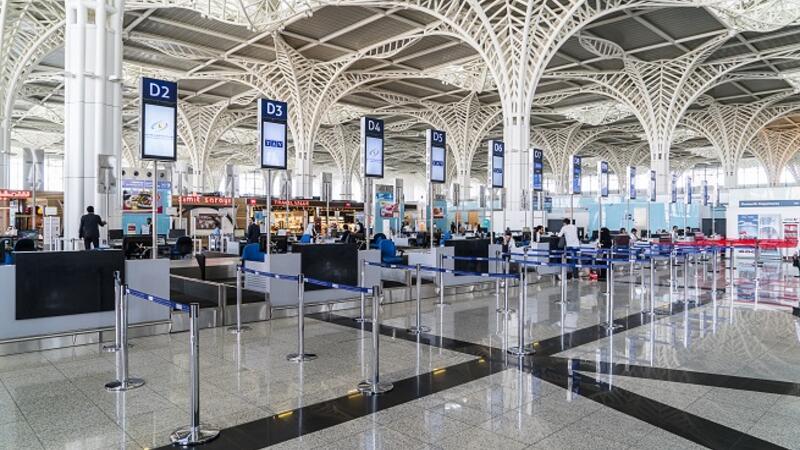
Upon arrival in Saudi Arabia, you will need to complete several procedures at the airport before proceeding to Makkah or Madinah.
The airport you arrive at in Saudi Arabia will depend on your Hajj or Umrah package. If you are traveling to Makkah first, you will land at King Abdulaziz International Airport (KAIA) in Jeddah. However, if your journey begins with a stay in Madinah, you will arrive at Prince Mohammad bin Abdulaziz Airport in Madinah.
Since most pilgrims arrive in Jeddah, this article will focus on the procedures at KAIA, though the process at both airports is largely similar. Madinah’s airport is smaller and generally less crowded, allowing for quicker processing, especially for Umrah pilgrims.
Although Makkah is only about an hour away from Jeddah’s airport, it may take up to 12 hours before you reach the holy city due to processing delays. Patience is essential, as there is little that can be done to expedite the process.
For those performing Umrah outside of Hajj season, the procedures are slightly different, and the wait time at the airport is typically much shorter. Please refer to the Umrah section at the end of this article for further details on what to expect.
The Hajj Terminal at King Abdulaziz International Airport (KAIA), Jeddah
A Gateway to the Sacred Journey
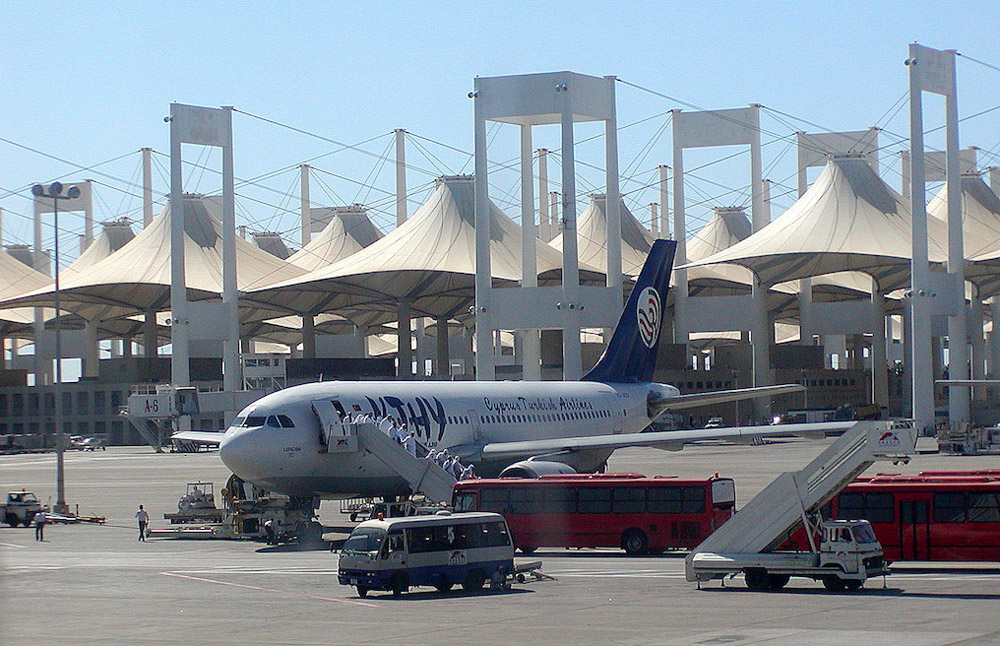
Every year, millions of Muslims from around the world embark on the spiritual journey of Hajj, and for many, the first stop is the Hajj Terminal at King Abdulaziz International Airport (KAIA), Jeddah. Designed exclusively to accommodate Hajj pilgrims, this terminal is not just an airport facility but a significant part of the pilgrimage experience.
Spanning an impressive 510,000 square meters, the Hajj Terminal is one of the largest in the world and can handle 80,000 passengers at a time. It serves as a crucial hub where pilgrims transition from their international flights to the sacred cities of Makkah and Madinah.
Facilities and Services at the Hajj Terminal
- Immigration and Customs Procedures
Upon arrival, pilgrims must go through immigration and customs clearance. Given the sheer number of arrivals, this process can be time-consuming, sometimes taking up to 6 to 12 hours before departure to Makkah or Madinah.
The Saudi authorities ensure a systematic process by organizing queues, checking passports and visas, and guiding pilgrims through baggage claim and customs checkpoints. While delays are common, patience and preparation make the process smoother.
- Medical Screening and Healthcare Services
Health and safety are a priority at the Hajj Terminal. Pilgrims undergo medical screening, where they may be required to present vaccination certificates for diseases such as meningitis or COVID-19.
The terminal is equipped with medical clinics and emergency response teams to assist those who may need medical attention. Special services are available for elderly and disabled pilgrims to ensure their well-being.
- Pilgrim Assistance and Multilingual Support
To cater to the diverse backgrounds of Hajj pilgrims, the terminal offers multilingual guidance services. Saudi Hajj authorities provide directions, assistance, and information in Arabic, English, Urdu, Turkish, French, and other languages.
There are also help desks and signage throughout the terminal to ensure that pilgrims can navigate easily through the complex.
- Resting Areas and Prayer Facilities
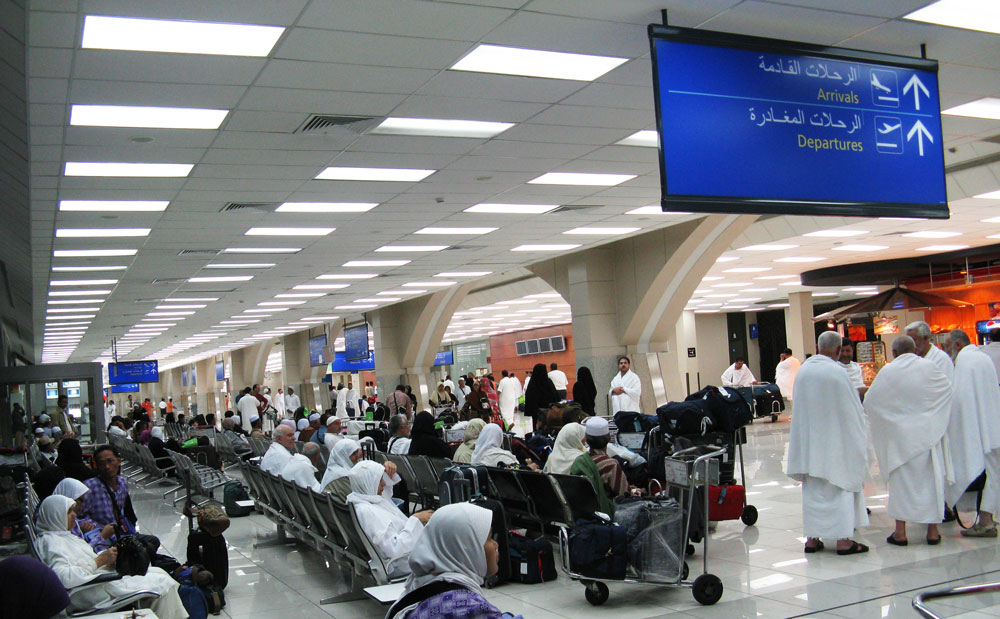
Since the wait time at the Hajj Terminal can be long, the terminal provides large prayer areas, comfortable seating, and shaded rest zones.
Ablution (wudu) facilities and clean bathrooms are available, ensuring that pilgrims can perform their religious duties before continuing their journey.
- Transportation to Makkah and Madinah
Once all airport formalities are complete, pilgrims board government-arranged buses or private transportation services to Makkah or Madinah.
- Jeddah to Makkah: The journey takes approximately 1.5 to 2 hours, depending on traffic.
- Jeddah to Madinah: If a pilgrim’s first stop is Madinah, they will travel by road for about 5 to 6 hours.
- High-speed train option: Pilgrims can also take the Haramain High-Speed Train, which reduces travel time between Jeddah and Madinah to about 2.5 hours.
What to Expect at the Hajj Terminal
- Long waiting times: It may take several hours before leaving for Makkah or Madinah.
- Strict procedures: Security and health checks are thorough, so compliance is necessary.
- Large crowds: The terminal is often crowded, requiring patience and calmness.
- Religious atmosphere: The experience at the terminal itself is spiritual, as pilgrims begin their sacred journey alongside thousands of others.
Final Thoughts
The Hajj Terminal is not just an airport facility; it is the gateway to one of the most profound journeys of a Muslim’s life. While the waiting time and procedures may test one’s patience, it is essential to approach the experience with a mindset of faith, gratitude, and endurance.
Saudi authorities continue to improve facilities and streamline processes to enhance the experience for pilgrims. With proper preparation, the transition from Jeddah to the holy sites can be smooth and spiritually uplifting.
Are You Preparing for Hajj?
If you’re planning your Hajj journey, make sure to stay informed about travel requirements, pack essentials, and most importantly, embrace the experience with patience and devotion. May your pilgrimage be accepted and blessed!
Arrival for Hajj or Umrah: What to Expect at the Airport
A Spiritual Journey Begins
The journey to Makkah and Madinah for Hajj or Umrah is a life-changing experience. However, before setting foot in these sacred cities, pilgrims must first go through the arrival process at the airport. Whether landing at King Abdulaziz International Airport (KAIA) in Jeddah or Prince Mohammad bin Abdulaziz International Airport in Madinah, understanding what to expect can help make the experience smoother and less stressful.
Arrival Procedures for Hajj and Umrah Pilgrims
- Immigration and Passport Control
Upon arrival in Saudi Arabia, all pilgrims must pass through immigration clearance. Here’s what happens:
- Pilgrims present their passports, visas, and entry permits to the immigration officers.
- Biometric data (fingerprints and photographs) may be taken for identity verification.
- Expect long queues, especially during Hajj season, as thousands of pilgrims arrive simultaneously.
- Patience is essential, as the process can take several hours.
- Baggage Collection and Customs Clearance
After immigration, you will proceed to baggage claim to collect your luggage. Keep the following in mind:
- Baggage handling may take time due to the large number of arrivals.
- Customs officers may inspect luggage to ensure compliance with Saudi regulations.
- Items such as alcohol, drugs, and non-Islamic religious materials are strictly prohibited.
- Health Screening and Vaccination Verification
Saudi authorities conduct health screenings to prevent the spread of contagious diseases. Pilgrims may be required to:
- Show proof of mandatory vaccinations (e.g., meningitis, COVID-19, yellow fever for travelers from certain countries).
- Undergo basic medical checks if necessary.
- Be aware that in case of a health concern, authorities may require further screening or isolation.
- Currency Exchange and SIM Card Purchase
Once airport formalities are complete, pilgrims may wish to:
- Exchange their money for Saudi Riyals (SAR) at currency exchange counters.
- Purchase a local SIM card for communication during their stay. Several mobile network providers offer special Hajj and Umrah packages.
- Ihram and Miqat Compliance
For those traveling for Umrah or Hajj, wearing Ihram before crossing the designated Miqat is a must.
- If you haven’t already changed into Ihram, you must do so before reaching the Miqat.
- Some airlines announce when the Miqat is approaching so that pilgrims can make their intention (Niyyah) and begin their pilgrimage in the state of Ihram.
Getting to Makkah or Madinah
- Transportation Options from Jeddah
If arriving at Jeddah’s King Abdulaziz International Airport, the journey to Makkah or Madinah is as follows:
- Makkah: Approximately 1.5 to 2 hours by bus or private car.
- Madinah: Around 5 to 6 hours by road or 2.5 hours by high-speed train.
- Transportation Options from Madinah
If landing at Prince Mohammad bin Abdulaziz Airport in Madinah, you have the option to:
- Stay in Madinah first and visit Masjid an-Nabawi before traveling to Makkah.
- Take a high-speed train or a bus to Makkah, which takes approximately 6 to 8 hours by road.
- Government-Arranged Transportation
During Hajj, the Saudi authorities manage pilgrim transport, including:
- Special Hajj buses that shuttle pilgrims from the airport to their accommodation.
- Organized train services to move pilgrims efficiently.
Final Tips for Pilgrims
- Stay patient: Expect long waiting times, especially during peak seasons.
- Keep travel documents handy: Make sure your passport, visa, and vaccination certificates are easily accessible.
- Follow airport staff instructions: Saudi officials are there to assist and guide you.
- Stay hydrated and carry snacks: It may take hours before you reach your hotel.
- Embrace the experience: The journey to Hajj and Umrah is a spiritual test; patience and gratitude will enhance your experience.
Conclusion
The arrival process for Hajj and Umrah may involve long waits and numerous procedures, but it is all part of the sacred journey. With the right mindset and preparation, you can navigate through the airport with ease and begin your pilgrimage with a heart full of devotion.
May Allah accept your Hajj and Umrah and grant you a blessed and rewarding journey!
Immigration
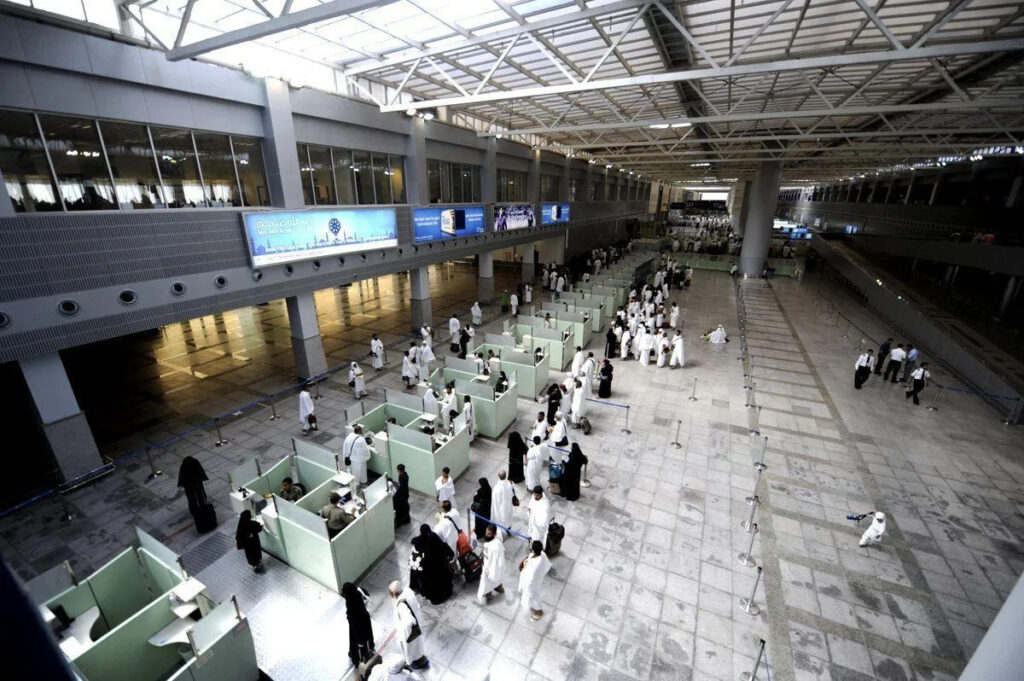
After your disembarkation card is processed, you will proceed to the immigration hall, where officials will check your passport, visa, vaccination certificate, and plane ticket. Immigration, customs, and baggage handling take place inside an air-conditioned facility.
Pilgrims will be separated by gender, with processing taking place on either side of the hall. Women should ensure they have easy access to their passport, relevant documents, and a spare set of luggage keys in advance.
Queues at immigration can be long, requiring patience and extended standing time before reaching an official.
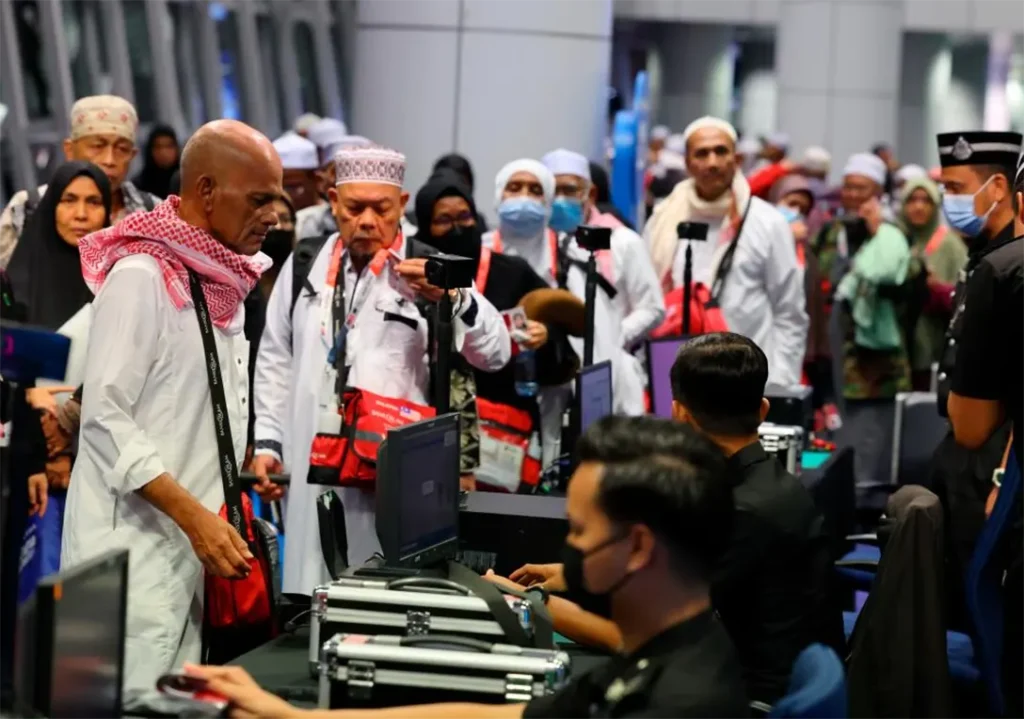
Health checks may also be conducted in this area, and vaccinations may be administered if necessary. Additionally, pilgrims may be fingerprinted and photographed as part of the entry process.
Luggage
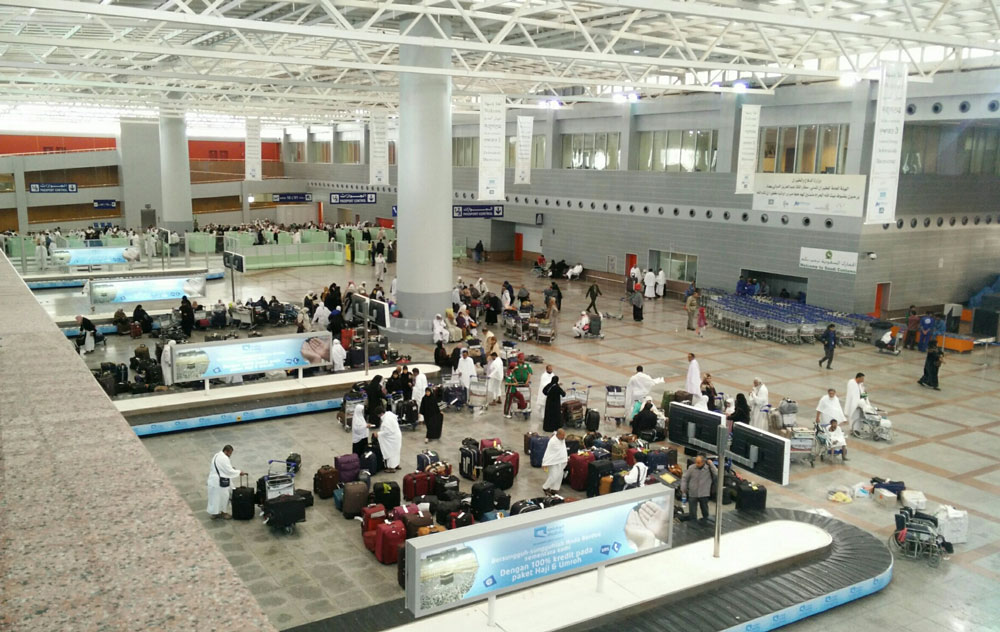
After completing immigration, proceed to the baggage claim area to locate your luggage, which may not always be on the conveyor belt as expected. Stay close to your group, as it is easy to get separated or misplace your belongings in the crowded space. To avoid confusion, ensure your bags are clearly marked with an identifiable tag or feature before your journey.
While luggage trolleys are available, they are in high demand and quickly taken once brought in by airport staff. Avoid stepping outside to collect a trolley, as security will not permit re-entry into the baggage claim area.
Customs
After locating your luggage, proceed to the customs checkpoint, where your bags will be inspected. Ensure all bags are unlocked before reaching the customs desk, as officials may require a thorough search of your belongings.
Avoid carrying magazines, literature, CDs, or DVDs that could be misunderstood or deemed inappropriate, as these items may be confiscated or cause unnecessary delays. If customs officials seize any items, do not argue or attempt to retrieve them.
If you are carrying medication, ensure it is clearly labeled to prevent any issues during inspection.
Once your bags have been checked, a customs official will affix a sticker to indicate that they have cleared the inspection process.
Processing
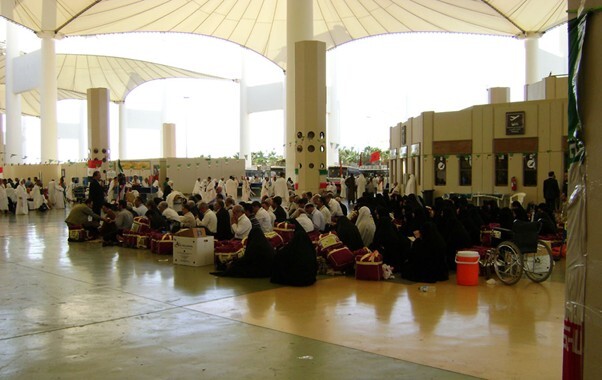
Once your luggage is sorted, you will exit the air-conditioned building into a vast, open-walled area covered by large tent-like structures, giving you a true sense of the Hajj Terminal’s immense size.
At this stage, a porter will place your luggage on a large trolley and transport it. Ensure you keep an eye on the trolley until your bags are offloaded, and have a group member secure the luggage in a safe spot to prevent it from being knocked over by the crowd.
Porters are paid for their services, so avoid giving them extra money, even if they insist. If pressured, do not engage in an argument—simply ignore the request and move on.
Avoid carrying magazines, literature, CDs, or DVDs that could be misunderstood or deemed inappropriate, as these items may be confiscated or cause unnecessary delays. If customs officials seize any items, do not argue or attempt to retrieve them.
If you are carrying medication, ensure it is clearly labeled to prevent any issues during inspection.
Once your bags have been checked, a customs official will affix a sticker to indicate that they have cleared the inspection process.
Mutawwif
In this area, pilgrims will be divided into groups based on the nationality listed on their passport and assigned a Mutawwif, also known as a Muassasah.
A Mutawwif is an official guide appointed by the Saudi Ministry of Hajj, responsible for assisting pilgrims with essential services such as transportation, accommodation in Mina and Arafat, and general guidance throughout the pilgrimage.
Each Mutawwif operates under a designated Mutawwif office (Muassasah office), which oversees the well-being of pilgrims from specific regions or countries. These offices are commonly referred to as the “National Tawafa Establishment for Pilgrims of [Region/Country]”, such as South Asia or Africa.
The following are some of the services that Mutawwifs provide during Hajj: |
Provide a photo ID card in place of your passport. Ensure you don’t lose this card as you need to present it in order to exchange money and also to reclaim your passport prior to departing Makkah or Madinah. If you lose it, report it to the office as soon as possible. |
Provide a bracelet/wristband which contains information about the Mutawwif office (including names, addresses and phone numbers) in case you get lost. |
Arrange transportation between Makkah, Madinah and Jeddah as well as transportation in and around Makkah during the days of Hajj. |
Provide accommodation (tents) in Mina and Arafat. |
Inspect hotel accommodation to check if it’s up to the required standard for pilgrims. If the hotel is not up to standard, the owner of the hotel can be fined. |
Mediate in disputes between pilgrims and agents/hotels. |
Assist with complaints and concerns about accommodation. |
Arrange ambulance and hospital facilities for pilgrims with illnesses and medical emergencies. |
Arrange funeral services and provide assistance with documentation in the event of a death. |
Take care of pilgrims who are lost or assist those looking for a lost pilgrim. |
Provide Hajj and Umrah books and other literature. |
Arrange tours of various places in and around Makkah, Madinah and Jeddah. |
The location of your camps in Mina, Arafat, and Muzdalifah will be determined by the Mutawwif office you are assigned to.
Upon arrival, your Mutawwif will collect your passport, which will be returned to you upon departure.
There are Mutawwif offices in Makkah, Madinah, and Jeddah, staffed with personnel who speak the languages of the countries they represent. It’s advisable to familiarize yourself with the location of your country’s office, as it may be helpful during your stay. Hotel receptionists in Makkah or Madinah can usually guide you to the appropriate office.
If the nationality on your passport differs from the country where you reside or from the members of your group, inform the officials. Present the visa in your passport, which was issued by the Saudi embassy in your country of residence—this is typically enough to ensure you are assigned to the same Mutawwif as your group. This step is especially crucial if family members hold different nationalities, as you wouldn’t want to be placed in separate camps across Mina, Arafat, and Muzdalifah.
When queuing, ensure you are in the correct line for pilgrims from your country of residence, not just your passport nationality. Being in the wrong queue may result in unnecessary delays and the frustration of having to start over in another line.
Travel Coupons
For Hajj pilgrims, a payment in the form of a banker’s draft or cheque is made to the Mutawwif to cover the services they provide during Hajj. This payment is typically included in the cost of your Hajj package and is arranged on your behalf by your travel agent.
The draft is stapled to your passport and is required to obtain travel coupons, which allow for transportation within Saudi Arabia. At the counter, an officer will remove the draft and attach a small booklet of travel coupons to your passport. These coupons contain barcoded stickers, which will be removed by officials as you travel throughout Saudi Arabia.
If you do not use these travel coupons—for instance, if you arrange your own transport or choose to walk during the five days of Hajj—you may request a refund upon departure at the Hajj Terminal. Before leaving, visit the Naqaba desk at the terminal, where you will need to present your passport, complete a form, and sign it in exchange for a voucher representing the value of the unused travel coupons. This voucher can then be redeemed for Saudi Riyals at a bank within the Hajj Terminal.
Facilities
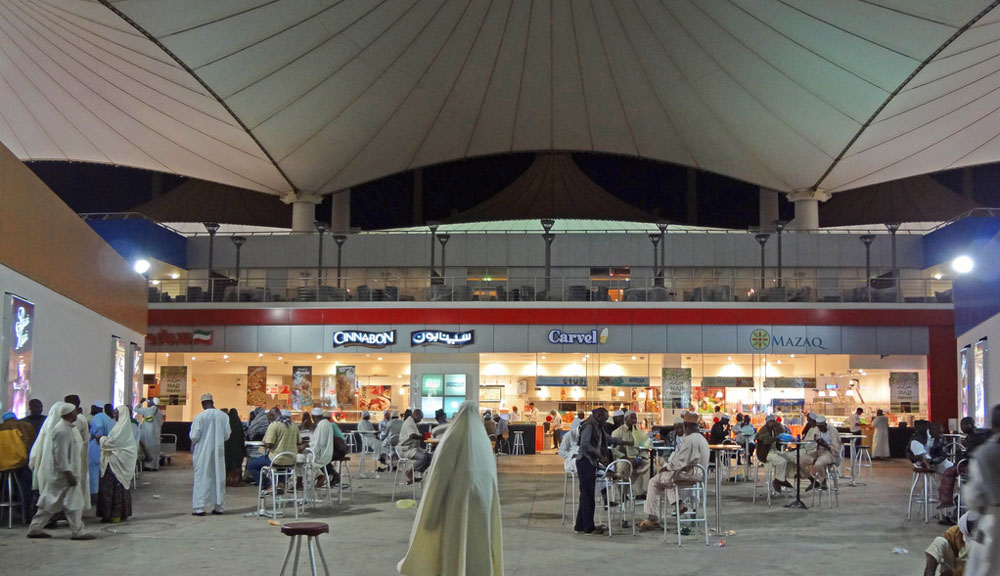
The procedures in the Hajj Terminal will take a fair amount of time so be prepared to wait.
The Hajj Terminal offers a range of facilities, including shops, toilets, showers, telephones, banking services, and informational support. If you haven’t already received a Saudi SIM card from your travel agent, you can purchase one from stalls set up by various mobile providers. Additionally, there are designated rest areas, prayer spaces, and seating arrangements for pilgrims.
Expect to wait for several hours at the terminal, so patience is essential. The facilities may not be as modern or efficient as those found in other international airports, and interactions with staff may not always be smooth. Keeping a calm and understanding attitude will help make the experience more manageable.
As mentioned earlier, the Hajj Terminal is vast, making it easy to lose your way. Once you have found a suitable spot to settle, take note of your exact location by observing the colour-coded walls and the alphabetically labeled sections of the terminal. This will help you navigate more easily and return to your spot if needed.
Money
If you prefer not to wait until you reach Makkah or Madinah to exchange your money, you can convert your cash at a bank within the airport.
When exchanging currency, request smaller denominations (e.g., one and five riyal notes), as they will be useful for purchasing snacks, drinks, and other small items. Shops, especially during Hajj season, can become extremely crowded, and waiting for change can be inconvenient.
Be mindful of pickpockets and thieves, who often target pilgrims in Makkah and Madinah. To keep your money and valuables safe, use a secure waist or neck pouch. If you don’t have one, you can easily purchase one upon arrival in Makkah or Madinah.
Onward Travel
Before leaving the Hajj Terminal, take the opportunity to use the restroom and refresh your wudhu, as you may not have access to facilities for some time.
Once all legal formalities are completed and you have received your travel coupons, you will be escorted to government buses for your journey to Makkah or Madinah.
At the bus, you will need to hand your luggage to staff in green overalls before boarding. As you step onto the bus, you must drop your passport into a bag held by the driver, after which you can proceed to your seat. This will be the last time you see your passport until your departure from Saudi Arabia.
Once on board, you will not be allowed to leave the bus, except during scheduled salah stops. The bus will only depart once all seats are filled, typically accommodating 45 to 50 pilgrims. Before departure, Saudi officials will conduct passport checks, and the bus will not be allowed to leave until these checks are completed—a process that can take a considerable amount of time.
It is a good idea to keep some small snacks and a bottle of water with you while you’re on the bus.
Umrah
The procedures at the airport for those performing Umrah outside the Hajj season are slightly different, resulting in a significantly shorter stay at the airport than those performing Hajj.
The key differences are as follows: |
Terminal – Even though the Hajj Terminal should also be used to process Umrah pilgrims, there may be instances where you are processed in one of the other terminals. If you’re unsure about which terminal to report to for your arrival and departure, ask your travel agent or get in touch with the airline you’re travelling with. |
Drafts/Cheques – Drafts aren’t required for those performing Umrah hence you won’t be designated a Mutawwif office, nor will your transportation be provided for in the form of travel coupons. Therefore, you can disregard the sections about Mutawwifs and travel coupons if you’re performing Umrah. |
Travel – Since you won’t be provided with travel coupons, you will have to arrange your own transport to Makkah and Madinah. Taxis and other forms of transport can be hired outside the terminal. Please refer to this article for more information about travel within Saudi Arabia. |
Passport – If you’re performing Hajj, your passport will be taken away from you, stored at the Mutawwif office for the duration of Hajj and returned to you on departure. This isn’t the case with Umrah. Once you have cleared immigration and customs, you will come across a “Tehsiliya” official whose role it is to register you electronically and see that you’re transported to Makkah. An official will guide you to your transport if it has already been booked by your travel agent, hand over your passport to the driver who will then return it back to you once you have reached your hotel. If you’re going to hire a taxi or another form of transport outside the terminal on your own accord, make sure you get your passport back from the official. It is illegal for anyone to withhold your passport if you’re not performing Hajj. |


