
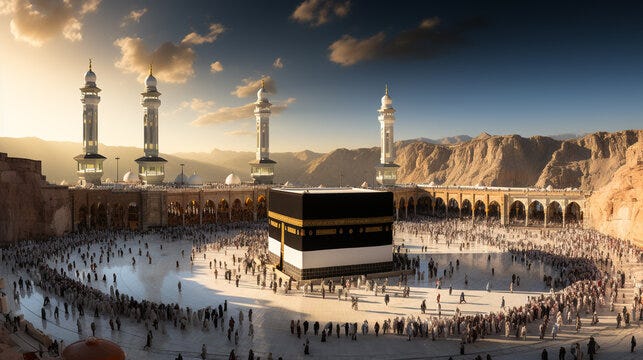
Umrah (Arabic: عمرة), often called the “lesser” or “minor” pilgrimage, involves performing a series of rites within the sacred grounds of Masjid al-Haram in Makkah. It comprises four essential acts and can be undertaken at any time of the year.
Meaning of Umrah
From a linguistic perspective, Umrah means “to visit a specific place.” In Islamic law (Sharia), it involves passing the Miqat in a state of Ihram, performing Tawaf around the Kaaba, completing Sa’i between Safa and Marwa, and concluding with Halq (shaving the head) or Taqsir (trimming the hair).
Umrah can be performed at any time of the year. However, it is generally discouraged to undertake it during the Hajj period, which falls between the 9th and 13th of Dhul Hijjah. The rituals of Umrah are also an essential component of Hajj itself.
Obligation of Umrah
Allah says in the Quran:
وَأَتِمُّوا الْحَجَّ وَالْعُمْرَةَ لِلّٰهِ
And complete the Hajj and Umrah for Allah.
[Surah al-Baqarah, 2:196]
The Prophet ﷺ performed Umrah four times during his lifetime. There is a difference of opinion among the four Sunni schools of thought regarding whether performing Umrah at least once in a person’s lifetime is obligatory or recommended.
According to the Hanafi and Maliki schools of thought, Umrah is not fardh (obligatory) but is regarded as a sunnah mu’akkadah (an emphasized sunnah). In contrast, the Shafi’i and Hanbali schools consider Umrah to be fardh, similar to Hajj.
Virtues of Umrah
Although Umrah isn’t an obligation for those who follow the Hanafi and Maliki schools of thought, there is still tremendous benefit and blessing in its performance, as mentioned in the following Hadiths:
Abu Hurairah I narrates that Allah’s Messenger ﷺ said:
(The performance of) Umrah is an expiation for the sins committed (between it and the previous one). And the reward of Hajj Mabrur (the one accepted by Allah) is nothing except Paradise.
[Narrated in Sahih al-Bukhari]
Abdullah ibn Abbas I narrates that the Prophet ﷺ said:
Perform Hajj and Umrah consecutively; for they remove poverty and sin as the furnace removes impurity from iron.
[Narrated in Sunan al-Nasa’i]
It was narrated from Abu Hurairah I that the Messenger of Allah ﷺ said:
The pilgrims performing Hajj and Umrah are a delegation to Allah. If they call upon Him, He will answer them; and if they ask for His forgiveness, He will forgive them.
[Narrated in Sunan Ibn Majah]
Types of Umrah
There are two types of Umrah:
- Umrah al-Mufradah – this type of Umrah is performed independently of Hajj and can be carried out at any point during the year except during the days of Hajj.
- Umrah al-Tamattu – this type of Umrah is performed in conjunction with Hajj and is normally carried out in the month of Dhul Hijjah, just before the commencement of Hajj. This particular type of Hajj is known as Hajj al-Tamattu and is the most common and easiest type performed by pilgrims.
Conditions for Performing Umrah
To perform Umrah, certain conditions must be met, which are the same as those required for Hajj:
- Islam – The individual must be Muslim.
- Maturity – They must have reached puberty (baligh).
- Sanity – They must be mentally sound and in full control of their faculties.
- Financial Capability – They must have enough funds to cover travel, accommodation, and other expenses during Umrah, as well as ensure financial support for their dependents during their absence. While being debt-free is not mandatory, arrangements should be made for any outstanding debts before departing.
- Physical Capability – The person must be in good health and free from any illness or condition that would prevent them from completing the rites of Umrah.
- Access to Transport – They must have the means and financial ability to travel to Makkah safely, without facing any significant harm or danger.
- Mahram Requirement (for women only) – Female pilgrims must be accompanied by a Mahram (a male guardian whom they cannot marry).
- Completion of Iddah (for women only) – Women must have completed their Iddah period (waiting period) if applicable.
Time for Umrah
Legally, there are no specific dates for performing Umrah; it can be undertaken at any time of the year. However, it should not be performed during the days of Hajj.
While there is no fixed timeframe, performing Umrah during Ramadan is highly virtuous, as highlighted by Abdullah ibn Abbas (رضي الله عنه), who said:
The Messenger of Allah ﷺ said to a woman from among the Ansar: ‘When it is Ramadan, perform Umrah then, for Umrah during it is equivalent to Hajj.’
[Narrated in Sunan an-NaSa’i]
Summary of Umrah
Below is a brief overview of the rites of Umrah. Refer to the article above for an in-depth look at how to perform Umrah.
Ihram: Steps and Guidelines
Preparation for Umrah
1. Purification:
Begin by clipping your nails, removing unwanted hair from under the armpits and around the navel, and trimming the moustache.
2. Bathing:
Perform a full ghusl (ritual bath). If that’s not possible, at least perform wudhu (ablution).
3. Ihram Attire:
Before reaching the Miqat, change into the Ihram.
For men: This consists of two white, unstitched pieces of cloth.
For women: Regular modest clothing that fulfills the requirements of hijab is sufficient.
It is recommended to wear the Ihram from the airport before departure.
4. Salah of Ihram:
After wearing the Ihram, perform two rak’ahs of salah:
In the first rak’ah, recite Surah al-Kāfirūn (109) after Surah al-Fātiḥah.
In the second, recite Surah al-Ikhlāṣ (112) after Surah al-Fātiḥah.
Make heartfelt du’a upon completing the salah.
5. Intention (Niyyah):
As you approach the Miqat (ideally while in the plane), make the intention for Umrah.
Ensure you are not wearing anything that violates the rules of Ihram.
It is recommended to make the intention verbally, in any language. You may say:
لَبَّيْكَ اَللَّهُمَّ عُمْرَة
Labbayka Llāhumma ʿumrah
“O Allah, I am here to perform Umrah.”
6. Talbiyah:
Begin reciting the Talbiyah:
لَبَّيْكَ اَللَّهُمَّ لَبَّيْكَ، لَبَّيْكَ لَا شَرِيكَ لَكَ لَبَّيْكَ، إِنَّ الْحَمْدَ وَالنِّعْمَةَ لَكَ وَالْمُلْكَ، لَا شَرِيكَ لَكَ
Labbayka Llāhumma labbayk, labbayka lā sharīka laka labbayk, inna l-ḥamda wa n-niʿmata laka wa l-mulk, lā sharīka lak.
“At Your service, O Allah, at Your service. At Your service, You have no partner, at Your service. Truly all praise, blessings, and sovereignty are Yours. You have no partner.”
Men should recite it aloud.
Women should recite it quietly.
Follow this with Salawat upon the Prophet ﷺ and personal supplications.
7. Journey to Makkah:
Continue your journey to Makkah while constantly reciting the Talbiyah, dhikr (remembrance of Allah), and Salawat.
8. Entering Masjid al-Haram:
Upon arrival, enter the Masjid with your right foot and recite the du’a for entering a mosque.
9. First Glance at the Kaaba:
Keep your eyes lowered until you see the Kaaba. Upon seeing it for the first time, say:
“Allāhu Akbar, Allāhu Akbar, Lā ilāha illa Llāh” three times.
Then raise your hands, make abundant du’a, and send Salawat on the Prophet ﷺ.
Tawaf al-‘Umrah (The Circumambulation of the Kaaba)
1. Idtiba (for men):
Men should uncover their right shoulder by passing the upper sheet of the Ihram under the right arm and over the left shoulder.
2. Starting Point:
Stand aligned with the Hajar al-Aswad (Black Stone), which marks the starting point of Tawaf. Look for the green light on the wall as a guide to this spot.
3. Intention (Niyyah):
Make your intention to perform Tawaf. A verbal intention is recommended and can be made in any language. You may say:
اللَّهُمَّ إِنِّي أُرِيدُ طَوَافَ بَيْتِكَ الْحَرَامِ فَيَسِّرْهُ لِي وَتَقَبَّلْهُ مِنِّي
Allāhumma innī urīdu ṭ-ṭawāfa baytika l-ḥarām, fa yassirhu lī wa taqabbalhu minnī.
“O Allah, I intend to perform Tawaf of Your Sacred House. Make it easy for me and accept it from me.”
4. Istilam:
If you can, kiss or touch the Hajar al-Aswad. If not, raise your hands towards it and say:
“Bismi Llāh, wa Allāhu akbar”
This act is called Istilam.
5. Begin Tawaf:
Begin walking around the Kaaba anticlockwise, keeping it on your left side.
6. Raml (for men):
During the first three circuits, men may walk briskly with short, quick steps and their chest slightly forward. This is called Raml. If the area is too crowded, you may walk normally.
7. Dhikr and Du’a:
Throughout Tawaf, you can recite Quran, make dhikr, personal du’a, and send Salawat on the Prophet ﷺ.
Between the Rukn al-Yamani (the corner before the Black Stone) and the Hajar al-Aswad, it is recommended to recite:
رَبَّنَا آتِنَا فِي الدُّنْيَا حَسَنَةً وَفِي الآخِرَةِ حَسَنَةً وَقِنَا عَذَابَ النَّارِ
Rabbana ātinā fi-d-dunyā ḥasanah, wa fi-l-ākhirati ḥasanah, wa qinā ‘adhāba n-nār.
“O our Lord, grant us good in this world and good in the Hereafter, and protect us from the punishment of the Fire.”
8. Completing a Circuit:
When you return to the Hajar al-Aswad, your first circuit is complete.
Make Istilam again and say “Allāhu akbar” to begin the next circuit.
9. Completing Tawaf:
Repeat this process until you complete seven circuits in total. You will have performed Istilam eight times—once at the beginning and once at the start of each remaining circuit.
10. End Idtiba:
After Tawaf, men should cover the right shoulder again by repositioning the Ihram.
11. Salah of Tawaf:
Pray two rak’ahs of salah after completing Tawaf. Ideally, this should be performed behind Maqam Ibrahim, with it between you and the Kaaba. If it’s too crowded, pray anywhere within the Masjid.
First rak’ah: Surah al-Kāfirūn (109)
Second rak’ah: Surah al-Ikhlāṣ (112)
Make heartfelt du’a after the prayer.
12. Zamzam:
Drink Zamzam water and make personal du’a while doing so.
13. Multazam:
If possible, go to the area between the Hajar al-Aswad and the door of the Kaaba (called the Multazam). Cling to this part of the Kaaba and make du’a sincerely. If reaching it is not possible, face it from a distance and make du’a.
14. Final Istilam (Recommended):
Before proceeding to Sa’i, it is recommended to perform Istilam of the Hajar al-Aswad one last time—making it your ninth Istilam.
Sa’i of Safa and Marwa
- Proceed to Safa – Go to the hill of Safa and make niyyah for Sa’i.
- Dua at Safa – At Safa, face the Kaaba and say Takbir (Allāhu akbar), Tahlil (lā ilāha illā Llāh) and send Salawat upon the Prophet ﷺ. Make as much du’a as possible here.
- Proceed to Marwa – On the way to Marwa, men should quicken their pace between the set of green lights. Women should continue normally.
- Dhikr & du’a – Do dhikr, du’a and Salawat of your own choice as you walk between the two hills.
- Dua at Marwa – After reaching Marwa, make du’a as you did at Safa. This is one lap.
- Return to Safa – Go back to Safa for your second lap.
- End of Sa’i – Repeat this until you have completed seven laps, finishing at Marwa.
- Dua and salah of Sa’i – Make du’a and perform two rak’ahs of salah in the Masjid.
Halq or Taqsir
- Exit the Masjid with your left foot and recite the du’a for leaving the mosque.
- To leave the state of Ihram and complete your Umrah, you must have your head shaved (Halq) or trimmed by at least an inch (Taqsir).
- Women may only have their hair trimmed.
- There are a number of men’s barber shops outside the Haram.


